.:[Double Click To][Close]:.
Showing posts with label Opel. Show all posts

Friday, December 3, 2010

Opel Amphibian Sport Cars Icona Concept

Opel Amphibian Sport Cars Icona Concept
The Opel Icona Concept Cars is a design study of a futuristic amphibian electric vehicle with a sporty design and retracteable wheels. Keeping such scenario in mind, Swedish designer Juan Pablo Bernal P has designed a futuristic vehicle for the year 2050 that moves on both land and water with equal efficiency. Called the “OPEL ICONA,” the V-shaped commuter vehicle features an aerodynamic body to ensure minimal air resistance for better performance in all conditions. The V shaped dynamic design uses distinctive shapes, forms, patterns and proportions which are express the sporty and leisure-oriented character of the vehicle.
Running on natural sources of energy, the all-electric vehicle generates power from electric motors to allow a clean and green drive. The zero-emission car would not only allow a sustainable drive but also become a means of entertainment to create a special bond between the family members as well as society.
The Opel Amphibian Sport Cars Icona Concept is a hybrid car that can traverse land and sea is nothing new despite being the stuff of dreams at least half a century ago, but this concept cars takes things to a whole new level. It can transport an adult and a child. The Opel Icona project was developed in collaboration with Opel by Juan Pablo Bernal at the Umea Institute of Design, Sweden.
Opel Amphibian Sport Cars Icona Concept
Opel Amphibian Sport Cars Icona Concept features two modes of operation Viz. Land mode and Water Mode to run on ground and water respectively. When the vehicle runs on the ground the sail remains wrapped in the storage area; however, as soon as the occupant puts the vehicle on the water mode the sail retracts and the wheel arms rotate inboard to reduce drag, thus enabling this vehicle to cruise on water with the same speed and elegance.
Opel Amphibian Sport Cars Icona Concept
About the Designer:
Juan Pablo Bernal is Colombian Designer with a Bachelor in Transportation Design from Instituto Europeo di Design (2003-2006) and a MA Degree in Transportation Design from Umea institute of Design in Sweden.
Among his working experiences are internship at the GM Europe Design and at Scania, Sweden.
Opel Amphibian Sport Cars Icona Concept

Saturday, October 9, 2010

Paris 2010: Opel GTC Paris Concept

Opel GTC Paris Concept

If there's one thing we can count on from the Paris Motor Show, it's a slew of sexy hatches. Opel was first out of the gate with the GTC Paris Concept, which the automaker is pitching as an obtainable sports car that can still haul five people if the need arises. Under that creased hood sits a turbocharged 2.0-liter gasoline engine good for 290 horsepower, though as small as the GTC Paris is, we can't imagine it would take much to get the hatch to hustle.

We're digging the GTC's hunkered stance, especially in the rear, where a set of flared hips dominate the vehicle's design. If you live in the old country and your mouth is watering at the thought of this slinky German, we've got bad news for you. As of right now, Opel has no plans to bring the GTC Paris Concept to life, but we'd put money on a production version within the next year.

Friday, October 8, 2010

Paris 2010: Opel Astra Sports Tourer

Opel Astra Sports Tourer

Opel is keeping busy, and aside from moving into a handful of new markets and pulling the sheets off of a hot concept, the German manufacturer has been whittling away on its wagon interpretation of the company's Astra. The 2011 Astra Sports Tourer wears the brand's trademark nose and sculpted sheet metal, but throws in an arching roofline for good measure. Inside, buyers can look forward to a set of snappy folding seats in the rear Opel claims should help make the car appealing to both families and small businesses looking to haul goods.

Power comes from either an uber-thrifty 95-horsepower engine or a more robust 180-pony lump, and a total of three transmissions are available – a five-speed manual, six-speed manual and six-speed automatic. The company says that European buyers can expect to see a start/stop system land on its 1.3-liter turbo-diesel engine in the Astra Sports Tourer as well

Thursday, June 10, 2010

2011 New Opel Astra GSI Concept Cars Third Millennium

The new Opel Astra GSi will be unveiled in October at the Paris Auto Show and will go on sale later this year or early in 2011. The 2011 Opel Astra GSi will feature various new design elements, including a re-styled front bumper, new wheel arches, a small rear diffuser and double exhaust pipes.
2011 New Opel Astra GSI Concept Cars Third Millennium
Opel fans al already asking when will the new Astra GSI will make its debut. Today we have the answer for them: the new 2011 Opel Astra GSI will make its debut this autumn at the Paris Motor Show, according to the latest reports from Auto Motor und Sport.
The new Opel Astra GSi 5-door layout back to talk about himself, with eloquent spy photos. The famous symbol will return to sport compact Russelsheim later this year. In fact, the Astra GSi will officially introduce yourself to October at the Paris Motor Show and will be sharing the catwalk in Paris with the new Sports Cars Tourer estate.
The new vehicle will carry, as expected, a 2.0-liter Turbo engine which will deliver around 190 hp… we do hope that this will get at least 200 hp in order to take on the Vw Golf GTI. Regarding the OPC version this will carry over 240 hp. The new Astra GSI will also come with a new body kit which will include wider wheel arches, a new front and rear bumper, new side sills, dual exhaust pipes and a dual-tone interior with Recaro sport buckets. Most sources say the 2011 Opel Astra GSi will only be available in the 5 door body style. The 3 door will be sold only as a OPC / GTC.
The new Opel Astra GSi be the top version of the variant 5-door, while the symbol OPC will be given only to the three-door GTC. The 2011 New Opel Astra GSi third millennium will be equipped with the 2.0 Turbo petrol engine, whose maximum should be around 190-200 horses. The Astra OPC boasts a 2.0-litre turbocharged motor with 177kW. The GSI should feature about 140kW or so.
The sports chassis will be recognizable to the wider wheel arches and front bumper changed. At the rear, as well as the letters GSi, Opel Astra in this version will be distinguished for the double exhaust. Even in the cockpit there are specific characterizations, such as two-tone sport seats.
The Astra GSi price will be announced at a later date.

Thursday, March 4, 2010

2011 Opel Vauxhall Ampera Plug-in Hybrid

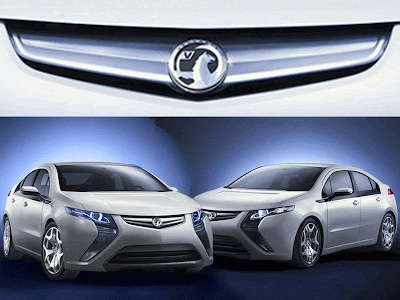
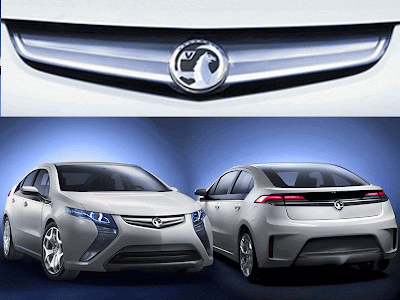
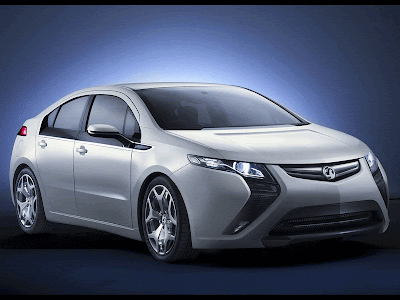
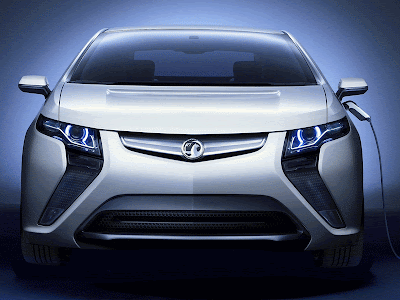
The most enlightening spy photos of the production version of the 2011 Opel Ampera plopped in our inbox today. At first we thought it was just the concept model out testing, but a closer look at the completely undisguised Ampera with the German license plates revealed that this is the actual production model that's due to go on sale in Europe and the UK (as a Vauxhall) in late 2011.
2011 Opel Vauxhall Ampera Plug-in Hybrid
Vauxhall Ampera will be unveiled along with Vauxhall Meriva compact MPV at the Geneva Motor Show 2010. Vauxhall Ampera, schedule for production late next year, is a five-door four-seater with same design DNA as Astra and the Car of the year-winning Insignia. Ampera uses extended-range electric vehicle (E-REV) technology. E-REV uses electricity as its primary power source, supplemented by a small engine to generate electricity for its motors when electric power runs low. This helps the Ampera overcome the ‘range anxiety’ issues associated with pure electric cars.
2011 Opel Vauxhall Ampera Plug-in Hybrid
Unlike other conventional propulsion systems, E-REV uses electricity as its primary power source, supplemented by a small engine to generate electricity for its motors when electric power runs low. This helps the Ampera overcome the ‘range anxiety’ issues associated with pure electric cars. Vauxhall will unveil not one, but two cars at this year’s Geneva Motor Show on March 2, with world premieres of the all-new Meriva compact MPV and a futuristic concept car, which is set to boost the company’s credentials as a leader in environmental vehicles.
2011 Opel Vauxhall Ampera Plug-in Hybrid
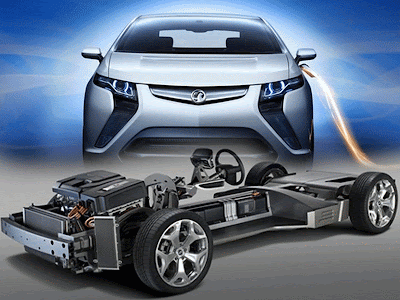
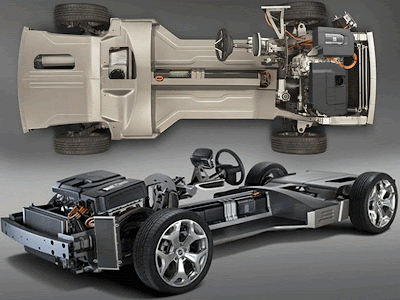
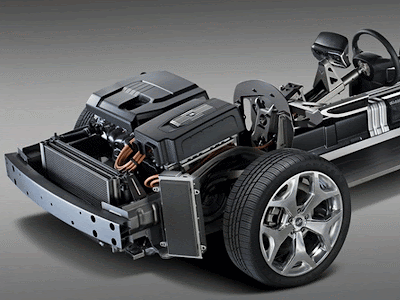
A quick recap of the details we already know, the Ampera will use the same plug-in hybrid gasoline-electric drivetrain as the Volt. It mates a powerful electric motor and a 16-kWh, lithium-ion battery pack to a 75HP 1.4-liter gasoline engine. But unlike conventional hybrids that use gasoline engines to power the wheels when the battery is depleted, the Ampera uses the petrol unit to generate electricity for the electric motor that always drives the (front) wheels. Owners will be able to charge the battery pack with a home outlet and drive for about 64km or 40 miles before the gasoline engine-generator kicks in to extend the Ampera's range to more than to more than 300 miles or 480 kilometers.
2011 Opel Vauxhall Ampera Plug-in Hybrid
Bolstering this message still further at the show will be the groundbreaking Ampera extended-range electric vehicle and Vauxhall’s most economical production car to date, the latest Corsa ecoFLEX.
2011 Opel Vauxhall Ampera Plug-in Hybrid
‘Vauxhall is covering all bases at Geneva,’ said Duncan Aldred, Vauxhall’s Managing Director. ‘With the Meriva, we have a unique and innovative take on family motoring, but the concept car and Ampera prove that we are truly at the forefront of environmental technology. These vehicles also show that their versatility and efficiency doesn’t come at the expense of stunning design.’

Saturday, February 27, 2010

2010 Opel Flextreme GT/E Concept with E-REV Drive System

Think of the Opel Flextreme GT/E concept as a bigger Chevrolet Volt (or Opel Ampera if you're European). The idea behind this concept, which will debut at the Geneva Motor Show (March 4 - 14, 2010), is to show how the Volt's extended-range electric vehicle drivetrain can be used in a larger vehicle, in this case a mid-size five-door hatchback. And it will boost the company's credentials as a leader in green technologies, offering expressive design with efficient environmental performance - and engineered with German precision.
2010 Opel Flextreme GT/E Concept with E-REV Drive System
In Opel's strategy for achieving more independence from fossil fuels, electricity plays a key role. The 4.7-meter long Opel Flextreme GT/E Concept illustrates how extended-range electric vehicle (E-REV) technology can be plugged into large or mid-size vehicles, as well as compact cars such as the upcoming Opel Ampera. Opel calls this strategy e-mobility unlimited: adapting the highly efficient E-REV drive system - which removes the limitations of battery-only power - to vehicles across all market segments. To enjoy zero CO2 driving emissions Opel-style, the Flextreme GT/E concept shows that size doesn't matter.
2010 Opel Flextreme GT/E Concept with E-REV Drive System
The purposeful design also enables the Opel Flextreme GT/E Concept to achieve a projected drag co-efficient of just 0.22, which helps it reach a 200 km/h-plus top speed as well as conserve energy and extend its driving range. Stand-out visual features include a low and wide stance, wing-shaped lights front and rear, a distinctive nose and grille, floating C-pillars and muscular, sculptured bodywork.
2010 Opel Flextreme GT/E Concept with E-REV Drive System
The clean, frontal styling features a low hood line and an extended nose section, which is clasped by wing-shaped, signature LED headlamps. These are deeply carved into the front fenders and across the hood line. The new trapezoidal grille execution is slim but bold. The prominent wing-shaped chrome bar carries a large Opel emblem, which doubles as a socket for charging the Opel Flextreme GT/E Concept's battery pack. The upper section of the grille is used to admit cooling air, the lower portion being covered by a translucent panel. The absence of additional air intakes allows a low frontal area for aerodynamic efficiency and also enables the Opel Flextreme GT/E Concept to meet future pedestrian protection requirements.
2010 Opel Flextreme GT/E Concept with E-REV Drive System
In profile, the Opel Flextreme GT/E Concept is distinguished by innovative, stubbed C-pillars. This floating design allows the glasshouse to be extended rearwards under the arching roofline, emphasizing the flowing lines of the side body. The car's dynamic character is further underlined by a fresh expression of Opel's signature blade motif, now a swooping swage line from the base of the C-pillar into the lower front fender. The translucency of the fixed glass panel in the center of the roof is adaptive, allowing sunlight to warm the interior in the cold of winter, but darkening for coolness in summer. A duct at the rear edge of the roof is for additional cooling of the battery and electronic components.
2010 Opel Flextreme GT/E Concept with E-REV Drive System
Integral to the Opel Flextreme GT/E Concept's expressive looks is the efficiency of the design execution. The small frontal area, low roof height (1308 mm) and a flat, enclosed underbody all enable the car to cleave the air with a minimum of disturbance. The 21-inch alloy wheels are relatively narrow, to reduce wind resistance, and fitted with 195/45, low rolling resistance tires. Clear, flush-mounted trim inserts also minimize air turbulence.
2010 Opel Flextreme GT/E Concept with E-REV Drive System
The Opel Flextreme GT/E Concept also explores the potential for active shape shifting. At speeds above 50 km/h, a vertical panel extends along the body from the air extraction slot behind each rear wheel-arch. These 350 mm-long side spoilers guide high-speed airflow around the rear corners of the car, further reducing the amount of turbulence.
2010 Opel Flextreme GT/E Concept with E-REV Drive System
Mass reduction measures for the body include the use of lightweight, carbon composite outer panels, polycarbonate window glazing and aluminum alloy structural components. Compared to conventional materials, these offer a 40 percent weight saving which further contributes to reduced energy consumption and an increased driving range.
The efficient concept also includes GM's ground-breaking E-REV drive system, already developed for the Opel Ampera. The Opel Flextreme GT/E Concept shows the versatility of this technology by displaying it in a larger, mid-size vehicle format.
2010 Opel Flextreme GT/E Concept with E-REV Drive System
Despite its greater size and a maximum speed of more than 200 kilometers per hour, the Opel Flextreme GT/E Concept is projected to offer performance similar to that of the Ampera: a battery-powered driving range of up to 60 km - with zero CO2 tailpipe emissions - and a total range of more than 500 km. Average fuel consumption is estimated at 1.6 l/100 km, with CO2 emissions of less than 40 g/km. Unlike a hybrid vehicle, the wheels of the Opel Flextreme GT/E Concept are powered at all times by electricity. For typical journeys up to 60 km, energy is supplied by a T-shaped lithium-ion battery pack located under the floor and rear seat.
2010 Opel Flextreme GT/E Concept with E-REV Drive System
However, unlike a battery-only electric vehicle, the Opel Flextreme GT/E Concept eliminates any possibility of range anxiety through fear of being stranded without power. The small gasoline engine/generator is seamlessly engaged to provide electricity whenever the battery's supply becomes depleted. In this mode, the driving range is extended to more than 500 km, until the plug-in battery pack can be recharged or the car is refueled. The motor in the electric drive unit delivers a substantial 370 Nm of instant torque, giving lively performance and projected zero to 100 km/h acceleration in less than nine seconds.
2010 Opel Flextreme GT/E Concept with E-REV Drive System
The Flextreme GT/E concept is a further step in Opel's unfolding strategy for the electrification of the automobile, which includes a wide portfolio of products using battery, extended-range, hybrid and fuel cell technologies.

Friday, September 18, 2009

Frankfurt 2009: 2010 Opel Astra

2010 Opel Astra

By now, you've likely already seen official shots of the 2010 Opel Astra, both inside and out. Of course, catching a glimpse of a new shape under the harsh lighting of an auto show often brings a different point of view than the automaker's own glitzy press shots.

In the case of the latest Astra, though, the new car looks nearly as fetching caught with the lenses of our own DSLRs as it did in GM's official photography. We especially like the new Astra's interior furnishings, which are a major step up from the current model's rather boring and somber duds.

While the 2010 Astra won't be coming Stateside as a Saturn like the previous model, GM has promised to bring the latest Detla-based car to American shores (probably in sedan form) wearing the trademark Buick badge and chrome waterfall grille, and none of those plans are expected to change now that The General has offloaded a majority stake in Opel to Magna.

Frankfurt 2009: 2010 Opel Insignia OPC Sports Tourer

2010 Opel Insignia OPC Sports Tourer


Meet the Opel Insignia OPC Sports Tourer. Salient facts: 325-horsepower turbocharged 2.8-liter V6, AWD, six-speed manual, eLSD torque vectoring and it's a station wagon. Oh, and get this -- it's built from off the shelf GM parts.

Wednesday, May 13, 2009

2010 Opel Astra revealed ahead of Frankfurt debut

2010 Opel Astra

After yesterday's impromptu internet unveiling of the 2010 Opel Astra, General Motors has finally let the details out on its next-generation compact before its official debut at the Frankfurt Motor Show this September.

The 2010 Astra's design is inspired by the Opel Insignia, sporting all-new sheet metal that takes cues from its mid-size sibling and packages it into a smaller, more fluid shape. The fascia, headlamps and rump remain true to Opel's new design direction, along with the sculpted sides and cab-forward greenhouse.

The same Delta 2 global platform used on the Cruze and Volt underpins the new Astra, measuring in at 174 inches, with a wheelbase that stretches 2.8 inches longer than the outgoing model. The "wing and blade" design employed on the exterior carries through to the interior, and joins ergonomic seats and the new Opel Eye front camera system, which recognizes road signs and warns drivers if they veer out of their lane.

Buyers abroad have the choice of eight different engines, including four CDTI common-rail diesels with displacements ranging from 1.3- to 2.0-liters and outputs between 95 and 160 hp. Another four gasoline-powered mills, with displacements between 1.4- and 1.6-liters, doll out between 100 and 180 hp along with a new turbocharged 1.4-liter that replaces the outgoing naturally aspirated 1.8-liter and puts out 140 hp and 14% more torque, while lowering fuel consumption.

PRESS RELEASE

New Opel Astra: The First Class Compact
  • Upscale: Exceptional technologies and innovations in the compact class
  • Spirited: Athletic sculptured design promises a thrilling driving experience
  • Agile: New mechatronic chassis raises bar in class for handling and comfort
Rüsselsheim. Integrating German engineering excellence, fluid sculptural design and accessible innovative technologies, the new Opel Astra captures the philosophy which quickly made the Insignia Europe's best-selling mid-sized sedan. Opel's new compact will premiere September 17 in Frankfurt at the IAA as a dynamic five-door hatchback with elegant touches that profits from the best of Opel engineering for a thrilling driving experience.

The next generation Astra brings many comfort and safety features to the compact class that the Insignia first introduced to mid-sized cars. Exceptional technologies like an all-new mechatronic chassis, the most advanced lighting system, a front camera that recognizes traffic signs and seat technology with the best ergonomics will be available.

"Opel's unique expertise of making new technologies accessible in compact cars is really highlighted with this tenth generation. In addition, the new Astra carries the spirit of the Insignia into the compact segment with unprecedented passion and commitment to excellence," says Alain Visser, Vice President of Opel.

At 4.42 meters, the new Astra offers increased passenger space and wellness in both the front and rear thanks to a 71 mm longer wheel base. Its slim and sleek body is designed for maximum efficiency in close collaboration between the designers and aerodynamic engineers who put the car through 600 hours of testing in a wind tunnel.

Elegant proportions give it a strong, cab-forward silhouette, with a steeply-raked windshield and falling rear roofline, adding visual excitement to the traditional hatchback format. The brand's new design language – sculptural artistry combined with German precision – is now seen in a different way.

"The design themes introduced in the Insignia, like the wing and the blade, have been given a fresh interpretation in the Astra, because it's important that each Opel model has its own personality," says Mark Adams, Vice President of Design, General Motors Europe. "This is why you see double wings in each of the rear lights and a dynamic inverted blade on the flank that visually connects to the powerful movement of the rear window and C-pillar."

The interior uses the same wing and blade design cues as the exterior, creating harmony inside and out. A special effort, too, has been made to add multiple flexible storage solutions.

"Opel's mission to make high tech innovations accessible has proven to be successful in the Insignia. We've set ourselves an even more ambitious goal in bringing most of these features to the compact segment with the new Astra," says Hans Demant, Managing Director of Opel.

Developed in Rüsselsheim, Germany, the Opel Astra also comes with an all-new chassis. Its longer wheelbase combines with wider tracks and a new rear axle construction to further enhance agility and stability with no compromise to comfort.

The Opel Astra's chassis has been developed as a mechatronic system that fully integrates mechanical functions and electronic controls. Like the Insignia, it can come with the clever Opel FlexRide electronic driving system, a rarity in this class, which offers the driver three settings – standard, Sport and Tour – while being fully and continuously adaptive to changes in driving style and cornering speed.

Other innovative technical features introduced to the compact class by the new Astra:
  • A new generation of bi-xenon Advanced Forward Lighting (AFL+) that changes its intensity and reach to suit prevailing drive and road conditions using nine different lighting functions.
  • The Opel Eye front camera system, which recognizes road signs and warns the driver when the car inadvertently departs from its lane.
  • Ergonomic front seats, developed for optimal back support and safety.
The powertrain line-up focuses on efficient performance and features eight Euro 5 compliant engines. All except the lowest powered units are equipped with six-speed transmissions. One new compact automatic gear box with Active Select function, for a clutch-free selection, will debut.

The CDTI turbo diesel line-up includes four common-rail, multiple injection units from 1.3 to 2.0 liter with outputs ranging from 70 kW/95 hp to 118 kW/160 hp. All are equipped with a Diesel Particulate Filter. An ecoFLEX version with particularly low fuel consumption and CO2 emissions will naturally be part of the program.

The four gasoline engines with 1.4 and 1.6 liter give a power bandwidth from 74 kW/100 hp to 132 kW/180 hp. A new, downsized 103 kW/140 hp 1.4 Turbo replaces the current naturally-aspirated 1.8. Thanks to exceptional high-tech features in this displacement range, the 1.4 Turbo develops 14 percent more torque yet maintains sensibly lower fuel consumption.

Grounded in the compact class tradition Opel initiated in 1936 with the first Kadett, the Astra has consistently made the top-three list of Europe's best-selling compacts – a segment which accounts for 27 percent of the total car market. Astra sales make up a third of all Opel/Vauxhall purchases, for an average volume of nearly 500,000 units per year.

2010 Opel Astra gets early web reveal

2010 Opel Astra
2010 Opel Astra
2010 Opel Astra

Opel's Astra hasn't exactly gone down a storm here in the U.S. while wearing a Saturn badge, but the four-cylinder econocar lineup is pivotal stuff in Europe, and the next-generation model could still find its way to America – even if it doesn't wear a planetary badge.

Regardless of whether or not a stateside version is in the cards, the 2010 Astra seen here is massively important. Based on General Motors' Delta platform (whose basic architecture underpins the Chevrolet Cruze and forthcoming Volt), the sixth-generation Astra will take the fight to cars like Volkswagen's Golf and Ford's Focus powered by a range of four-cylinder engines. According to CarScoop, the Astra will be available with a normally aspirated 1.4-liter gasoline inline-four, but turbocharged variants will also be available, offering between 120- to 140 horsepower and 175 to 200 Nm of torque (129 – 148 pound-feet). More power will reportedly come in the form of a 180 hp 1.6-liter turbo motor. Naturally, being a European offering, a range of diesels will also be available, including 1.3-, 1.7- and 2.0 –liter variants. A particularly miserly ecoFLEX variant is also expected in 2010.

If CarScoop's sources are right, the five-door Astra will hit showrooms in the autumn, with a three-door GTC Coupe fastback to follow. A wagon, four-door sedan, and a retractable hardtop model are expected to fill out the range thereafter.

[Source: CarScoop]

Wednesday, March 4, 2009

Opel goes Voltec, Ampera coming in late 2011

Opel Ampera concept

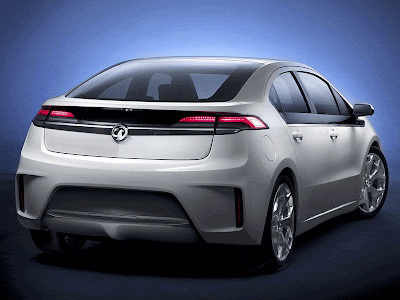
General Motors Europe boss Carl-Peter Forster began this morning's press conference in Geneva with an acknowledgment of the dire financial straights that the entire industry is experiencing right now. Forster also candidly admitted that GM is currently investigating all options when it comes to changing its relationship with Opel, including outside equity investments. Once he got past all the bad news, however, he introduced the production-intent version of the Opel Ampera. If it looks familiar, it should. If it doesn't, well, what rock have you been hiding under for the last two years? The Ampera is the Opel badged variant of the Chevrolet Volt. It uses the same Voltec powertrain as the Volt, as well as most of its body.

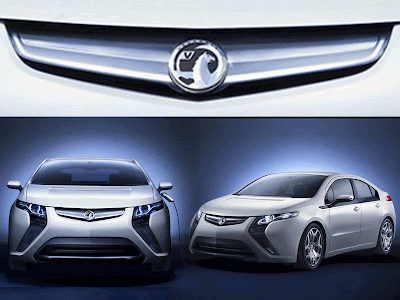
The main differences are the markedly more aggressive front and rear fascias and the black (rather than white) interior. Like the Volt, most of the front fascia is closed off to optimize aerodynamics. The styling of the nose is a mix of the 2007 GTC and Flextreme concepts, and we rather like the bold new look, particularly the chevron-like forms that grow downward from the headlamps.

The Ampera is planned for production in late 2011, about one year after the Volt. A right-hand drive Vauxhall version is scheduled to launch a year after that.


March 2, 2009


Geneva World Premiere: Opel Ampera to Debut in 2011

Electric car with 500 km extended range

Geneva/Rüsselsheim. The revolutionary Opel Ampera today celebrated its world premiere at the 79th Geneva Motor Show. General Motors Europe president, Carl-Peter Forster, unveiled the extended-range electric vehicle and announced plans to put the car into production in late 2011.

The Ampera will also be offered with right-hand drive in the United Kingdom by Opel's sister-brand, Vauxhall.
"The Opel Ampera further demonstrates GM's leadership in the electrification of the automobile," said Carl-Peter Forster. "Its ground-breaking Voltec electric propulsion system is the kind of game-changing technology the automotive industry needs to respond to energy and environmental challenges."

The five-door, four-seat Ampera is influenced by Opel's award-winning design language of sculptural artistry meets German precision, incorporating several styling cues from the innovative Flextreme and GTC Concept show cars
"There could not be a more fitting way to celebrate Opel's 110 years of innovation in the car industry than by revealing the Ampera," said Alain Visser, GME Vice President Opel.

The Ampera's wheels are turned electrically at all times and speeds. For journeys up to 60 km (MVEG), it runs on electricity stored in the 16-kWh, lithium-ion battery, and emits zero CO2. When the battery's energy is depleted, electricity from an engine-generator extends the Ampera's range to more than 500 km.

The Ampera can be plugged into any household 230v outlet for charging. GM Europe is analyzing the requirements of a recharging infrastructure for plug-in electric cars with energy companies, including Iberdrola of Spain.

Monday, March 2, 2009

First official image: Opel Ampera

Opel Ampera

With the Geneva Motor Show set to kick off this week, the dam holding back any remaining images and info is ready to burst. Exhibit A: the Opel Ampera. We've seen it leaked on the European Registry site, teased by GM, and spied in the wild. Today, the first full, official shot has been released, and honestly we have to wonder whether GM would have been better off giving the Chevy Volt the Opel's fascia. Seriously, for a car that's supposed to be so important, cutting-edge and revolutionary, the Volt looks pedestrian compared to the Ampera. The European cousin gets a more modern, and frankly, more attractive appearance. Sure, underneath, it's all the same tech, and the two cars' profiles are identical. But the Ampera's clearly the head-turner of the two. The Volt? Not so much.

[Source: GM]

Thursday, July 24, 2008

Insignia will come to U.S. as a Saturn, with new sheetmetal, interior

Opel Insignia

Despite repeated rumblings from industry sources (including Lutz himself) that the Opel Insignia's transformation into a Saturn model was on hold, Bob Lutz now indicates that work is indeed proceeding on making that model ready for the American market. Changes are going to be made to both the interior and the exterior of the Insignia as it morphs into the Aura. Lutz also indicates that the two Epsilon II-based cars will share suspension bits and powertrains, though we are not sure just how many of the six available gas and diesel engines in the Euro-only Opel will make their way Stateside. Also debatable is the Insignia's Haldex all-wheel-drive system that will be offered across the pond. Whatever the case, we hope that the car doesn't see too many changes as it's an extremely attractive and compelling package as it currently sits. Bring it.

Monday, July 14, 2008

Opel and Vauxhall versions of Volt to be built in U.S.

Opel Flextreme concept


When the Volt concept was first unveiled, GM was not sure how to badge European versions of the E-Flex cars. Apparently, the decision has been made and the first Euro-bound EV's from GM will be badged as Opels, with a Vauxhall version coming shortly thereafter. All three models of the E-Flex chassis will be built in Detroit atop the next-gen Delta compact car platform which was designed to carry a large lithium ion battery pack along with a range-extending engine. Though the Europeans would likely favor a diesel powerplant, it seems that the first-generation of all three E-Flex vehicles will use a gasoline-powered engine for on-the-fly battery recharging.

It goes without saying that the Volt and its Euro-clones will be the most expensive vehicles built on the Delta platform, with U.S. pricing estimated to be at least $40 grand. Across the pond, the Opel and Vauxhall E-Flex's will be saddled with at least a 10,000 euro premium. The price of gasoline, which is significantly higher in Europe than in the States, along with any government assistance for purchasers of the EVs, will determine how quickly customers will recoup that added investment.

Sunday, May 11, 2008

Spy Shots: Opel Insignia five-door hatch caught

Opel Insignia five-door
Over in Europe, midsize cars like the Opel Vectra, Renault Laguna and Ford Mondeo have long been offered in multiple body configurations including four-door sedans, station wagons and, of course, five-door hatchbacks. Unlike Americans, who for some reason are averse to a fifth body opening unless the vehicle rides 4 to 6 inches higher than it should, Europeans have always appreciated the extra utility. The Opel Vectra is being replaced this summer by the redesigned and renamed Insignia, but so far we've only seen photos (either spy pics or official GM shots) of the four-door sedan that will likely land here later next year as the next Saturn Aura. A sharp-eyed photographer, however, has captured what may be the first shots of the new hatchback Insignia. The five-door version doesn't look radically different from the sedan, the main variance being the shorter rear deck that's attached to the rear glass. Will the hatchback arrive as an Aura at Saturn dealers? Highly improbable, but then so was the Astra, so anything is possible. We more likely might just get a wagon version that we haven't yet seen.

Monday, April 14, 2008

2009 Opel Insignia

Opel Insignia

After many spy shots of the future Insignia here are the first official images! The car will make its official debut in July at the London Motor Show and will go on sale in October.
Opel Insignia
Even if there are no official informations about engines, is supposed to be powered by either a 1.6 liter or a 2.0 liter turbo engine. A 2.8 liter V6 engine that produces 250 hp is also under consideration. Diesel versions will include 1.9 liter engine with output between 120 and 150 hp. The 1.9 liter engine is already used in the Saab 9-3 and the Cadillac BLS.Opel Insignia

An OPC version will also be unveiled at a later date and will be powered by a 2.9 liter V6 diesel engine that delivers 300 hp.